





The African Agri Investment Indaba, held last week, shifted the continent’s agricultural conversation from individual innovations to a far more ambitious and unified vision.
Rather than celebrating isolated breakthroughs, the event framed African food security as dependent on an integrated technological ecosystem one where drones, circular bio-economies and intelligent infrastructure operate as interconnected components of a resilient agricultural system.
The dialogue quickly moved beyond the familiar question of what each technology could achieve. Instead, speakers explored the transformative potential unlocked when these tools work in concert. Gerrit van Rensburg of SkyFarmers opened the discussion by demonstrating how modern agricultural drones had evolved far beyond aerial spraying. These machines now collect granular, real-time data that identifies precisely where interventions are needed. He argued that such information forms the essential “foundational layer” of every smart and responsive farm.
Building on this, Gerald Nel of Grüner and FARA presented how that data could power the Integrated Bio-Circular Networks Africa (IBNA). Within this model, predicted crop residues and agricultural waste cease to be by-products. Instead, they become vital resources converted into renewable energy and organic fertiliser that feed back into farms and processing centres. This closed-loop system illustrated how data-driven production and circular resource use reinforce one another.
The system’s environmental benefits were then linked directly to financial opportunity. Sabrina Basson of EmitiQ explained how regenerative practices, supported by precision insights and circular processes, contribute to measurable carbon sequestration. She showed that these gains allow farmers to access carbon markets, effectively turning improved soil health into a new revenue stream. This, she noted, creates a powerful economic rationale for adopting sustainable farming practices.
Yet improved production meant little without safeguarding harvests. Bühler’s Marco Sutter highlighted the next critical step: smart storage solutions capable of drastically reducing post-harvest losses. With nearly 30% of Africa’s grain historically wasted after harvest, his presentation underscored how intelligent silos able to detect spoilage, pests and mycotoxins protect the value created throughout the farming cycle.
Finally, Roble Sabrie of the FAO brought the conversation full circle by linking technological progress to trade and food access. He emphasised that even the most advanced farming systems depend on reliable transport routes. Efficient pathways such as the Lobito Corridor, he explained, are essential: “Corridors are the circulatory system,” he said, “moving healthy produce from robust agricultural hearts to hungry markets.” Cutting logistics costs by nearly half, these corridors ensure that the gains made on farms reach regional consumers and global markets.
By the close of the Indaba, one message was unmistakable: Africa’s future lies not in isolated interventions but in a cohesive, interlinked agricultural framework. This vision where precision data enables circular economies, environmental gains are monetised, production is protected by intelligent storage, and goods travel efficiently to market offers investors a compelling, systemic opportunity. It promises an agricultural transformation that is resilient, competitive and genuinely future-ready.
African Agri Investment Indaba promotes food security
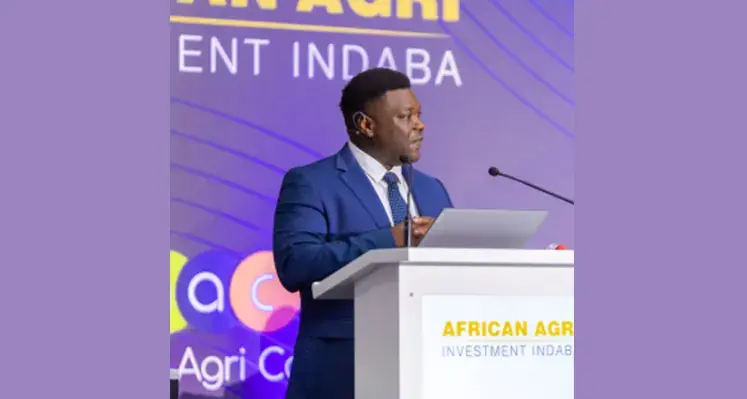
Africa’s future lies not in isolated interventions but in a cohesive, interlinked agricultural framework. (Image credit: AAII)