





Dorper sheep breeding in Zimbabwe is experiencing renewed growth, with rising demand, strong auction prices and expanding breeder participation signalling a positive turnaround for the sector.
This upward trajectory was highlighted by the first-ever Dorper sale held in Matabeleland on 28 November 2025 in Bulawayo - a landmark event for the country’s small-stock industry.
Zimbabwe Dorper Sheep Breeders Association chairperson William Hundermark told that Matabeleland had never previously hosted a Dorper sale. He explained that Zimbabwe’s stud breeding industry, including the Dorper breed, suffered heavily during the land redistribution programme, which led to the emigration of many established breeders. The situation was further compounded by recurring foot-and-mouth disease outbreaks, which restricted livestock movement and prevented large-scale auctions.
Hundermark described the Bulawayo auction as a major breakthrough, noting that it exceeded expectations. “The top registered Type 5 ram sold for US$2 000 (around R33 864), and several others sold in the range of US$1 800 to US$1 850 (R30 476 to R31 322). Many rams achieved US$1 500 to US$1 550 (R25 397 to R26 244), and even the Type 4 unregistered rams made between US$1 000 and US$1 500 (R16 932 to R25 397). The Type 3 rams ranged from US$600 to just over US$1 000 (R10 159 to R16 932,” he said. “For a sale with no prior track record in the region, these prices were phenomenal.”
Providing further context, Hundermark referenced the Zimbabwe Herd Book National Breed Sale held in July 2025, where a Dorper ram from his Northern Dorper Stud fetched a record US$4 300 (R72 808). Average ram prices stood at US$2 700 (R45 716), while ewes sold between $550 and $600, with a top price of US$700. “What this tells us is that across Zimbabwe, demand for quality Dorper genetics is climbing sharply. Farmers are seeing the value in small-stock, and Dorpers keep proving themselves year after year,” he said.
Demand for breeding ewes and rams continues to rise, with shortages already emerging. The association now has nearly 80 members, compared to just six in 1958, reflecting the breed’s growing national footprint.
Veteran breeder Rose van de Ruit, who began with 20 sheep in 1998 and now manages a flock exceeding 400, emphasised the importance of genetics and management.
“Over the years, I have learnt the importance of selective mating and the role genetics plays in the breeding of good animals,” De Ruit said.Despite persistent challenges such as high feed costs, vaccine shortages, limited access to land and finance, Hundermark remains optimistic. “Overall, these challenges are real, but they can be solved with coordinated planning, industry unity, and supportive national policy,” Hundermark concluded.
Dorper sheep breeding is thriving in Zimbabwe
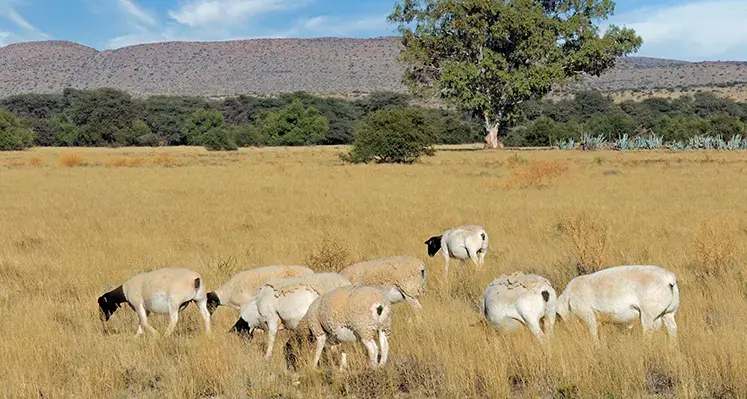
Demand for breeding ewes and rams continues to rise, with shortages already emerging.