Gabon has received its first 37,600 day-old chicks under an emergency poultry programme designed to raise domestic broiler production ahead of a planned ban on broiler chicken imports from January 2027
The Ross chicks arrived in Libreville on 19 November and were sent to eight farms in Estuaire province. The delivery marks the start of the first phase of the Plan opérationnel d’urgence de la filière avicole (POUFA), which covers 262,400 chicks scheduled to reach participating farms between 19 November and 17 December. A wider order of three million birds forms part of the government’s effort to expand the national poultry industry.
The programme comes as Gabon prepares to prohibit imports of broiler chicken from 1 January 2027. The government has maintained the deadline while coordinating measures to increase local output and help producers prepare. The policy is intended to reduce reliance on imported poultry, but its implementation will depend on whether domestic farms can consistently supply enough chicken at affordable prices.
Support extends beyond chick deliveries
POUFA covers 150 farms selected through an expression-of-interest process launched in March. Government assistance includes day-old chicks, poultry feed, and veterinary products, recognising the need to address multiple production requirements simultaneously.
Under the first disbursement, 81 farms are due to receive 262,400 chicks, 1,200 tonnes of feed and veterinary supplies. The government reported that CFA1.427bn was disbursed on 29 September, while three payment orders totalling CFA3.1bn had been submitted to the Treasury by 11 November.
Veterinary kits were distributed to 79 farms across eight provinces to improve disease prevention and prepare housing for incoming birds. The first consignment went to eight farms in Estuaire, with transport security arrangements in place. For farms beyond the province, authorities said deliveries would involve governors and local administrative officials.
The Central Purchasing Agency of Gabon (CEAG) is responsible for securing supplies, including supplier negotiations, imports, delivery and traceability. The programme also involves the General Directorate of Livestock, the Gabonese Institute for Development Support (IGAD) and private partners, including Société meunière et avicole du Gabon (SMAG) and Points Verts.
Production target remains a major challenge
The government expects around 500 tonnes of locally produced broiler chicken to enter markets and retail outlets in Libreville from 24 December, following the first production cycle. Its November assessment projected national output of 796.7 tonnes by 1 January 2027, including 348 tonnes from farms outside POUFA.
The longer-term ambition is considerably larger: 120,000 tonnes of broiler chicken annually. Government figures put the production potential of the 150 supported farms at 961.7 tonnes. Investments worth CFA7.163bn, financed by the Bank for Commerce and Entrepreneurship of Gabon, are expected to increase capacity during the first quarter of 2027. Once completed, participating operators are projected to accommodate 391,000 chicks per cycle and produce an estimated 4,222.8 tonnes of chicken annually.
Even after the planned expansion, supported farms would account for only a fraction of the national target. The government expects agro-industrial operators to provide much of the additional volume, alongside the gradual spread of poultry farms across all nine provinces.
The first delivery gives POUFA an operational start. Reliable feed and veterinary inputs, farm management, disease control, transport and regular market distribution will determine whether producers can sustain output beyond the opening cycle. With the import restriction approaching, Gabon’s ability to build a consistent domestic supply will be central to the success of its poultry expansion plan.
Gabon starts poultry expansion ahead of chicken import ban
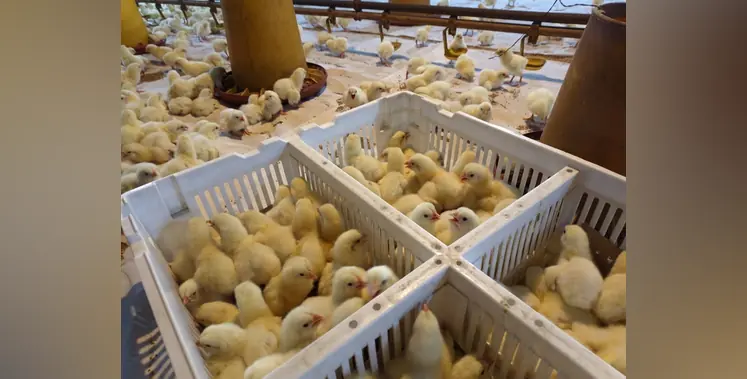
Gabon’s POUFA programme will distribute 262,400 chicks to local farms in its first phase, supporting efforts to replace imported broiler chicken with domestic production.