More than 600,000 agricultural drones are now being used across over 100 countries, bringing new possibilities for crop seeding, spraying and field management
Their growing presence reflects the speed at which farmers are adopting aerial technology to carry out time-sensitive operations, reach difficult terrain and reduce the use of agricultural inputs. However, regulatory restrictions, particularly on pesticide application, continue to limit how widely the equipment can be deployed in some markets.
The issue came into focus at the ‘Drones in Agriculture’ conference organised by Edagricole/Tecniche Nuove during EIMA International 2026 in Bologna, Italy. Industry estimates presented at the conference indicated that agricultural drones saved 410 million tonnes of water and reduced carbon dioxide emissions by 51 million tonnes in 2025. The figures originate from DJI Agriculture's 2025/2026 industry report and refer to the company's global agricultural drone fleet.
Farm applications demonstrate operational gains
The commercial case for agricultural drones is increasingly supported by examples from working farms. Their ability to operate above standing crops, navigate uneven terrain and access fields unsuitable for conventional machinery makes them particularly useful for seeding and crop treatment.
Ichem Iderrami, an engineer at DJI Agriculture Italia, highlighted timely intervention, operational flexibility, reduced crop damage and data integration among the main advantages. Depending on the equipment and application, drones can cover a hectare in less than five minutes.
Case studies presented at EIMA illustrated the potential across different crops. In Italy, a drone sowed three hectares of rice in five minutes. A maize production operation in the United States recorded a 50% increase in yield, while vineyard treatment in Romania reduced plant protection product use by 53%.
Regional trials in Italy have provided further evidence of their performance. In Lombardy, tests conducted in rice fields recorded 99% herbicide effectiveness against the main weeds, excluding persicaria. The drone applied 40 litres per hectare, compared with 200 litres using conventional equipment. Vineyard applications required 100 to 150 litres per hectare, against 1,800 litres for conventional treatment, with spraying completed six times faster.
The results also revealed limitations. Protection against downy mildew in vineyards remained less effective than conventional spraying, indicating that reduced application volumes do not necessarily deliver equivalent crop protection.
Pesticide application remains a regulatory challenge
While agricultural drones are already being used for monitoring, mapping and several field operations, their legal status becomes more complicated when they are used to distribute agricultural products.
At the EIMA conference, lawyer Maria Flaminia De Capua explained how European aviation rules and national legislation govern their operation. In Italy, the Italian Civil Aviation Authority (ENAC) oversees aviation-related requirements.
Low-risk operations meeting the conditions of the EU's Open category, including applicable weight, flight and operational restrictions, do not require specific ENAC authorisation. Higher-risk activities fall under the Specific category, where operators must obtain the necessary clearance and demonstrate that potential risks to people and property have been assessed.
Pesticide spraying faces an additional restriction. European legislation generally prohibits aerial application of plant protection products, allowing exceptions under defined conditions. Italy introduced a legal provision in December 2025 to permit experimental drone-based pesticide treatments, but implementation depends on an interministerial decree identifying eligible land, crops, pests and products. A parliamentary amendment approved on 4 November 2026 also established that the three-month experimental period would begin only after publication of the decree.
Consequently, the legislative change has not yet opened the way for unrestricted commercial spraying by drone. Operators must continue to comply with existing aviation and plant protection requirements.
Regional trials point to further opportunities
Research by the plant health services of Lombardy and Emilia-Romagna is helping establish where aerial application can be useful and where improvements are still needed.
In Emilia-Romagna, trials covered potatoes, tomatoes, onions and vineyards. The work was particularly relevant following severe flooding in 2023 and 2024, when waterlogged fields and inaccessible plots prevented conventional machinery from reaching some crops within suitable treatment windows.
Results from horizontal crops showed promising spray deposition and treatment effectiveness. However, some tests recorded greater drift beyond treated areas than conventional application, highlighting the importance of controlling environmental exposure.
The findings suggest that agricultural drones could offer valuable support when difficult field conditions prevent timely intervention. Their broader use, however, will depend on demonstrating consistent treatment performance and meeting safety requirements.
With adoption already established across international farming markets, the challenge is no longer simply developing equipment capable of carrying out agricultural operations. Clearer regulatory procedures, supported by field trials and evidence of safe application, will be essential to bringing the technology's full range of uses into commercial practice.
600,000 agricultural drones put farming regulations in focus
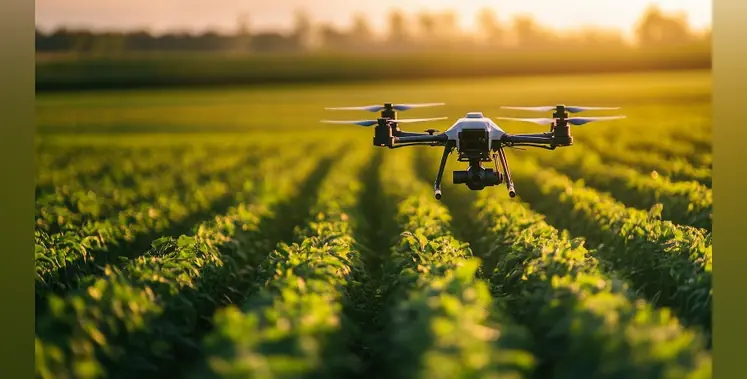
The growing presence of agricultural drones reflects the speed at which farmers are adopting aerial technology to carry out time-sensitive operations, reach difficult terrain and reduce the use of agricultural inputs.