




Africa has taken a major step towards closing its long standing agricultural mechanization gap as leaders, experts and development partners gathered in Dar es Salaam for the Africa Conference on Sustainable Agricultural Mechanization.
The event opened with the launch of Tanzania’s National Agricultural Mechanization Strategy 2026 to 2036, signalling a renewed continent wide push to modernise farming systems.
The strategy was unveiled by the Prime Minister of the United Republic of Tanzania, Mwigulu L. Nchemba, alongside FAO Deputy Director General Beth Bechdol. The conference is organised by the Food and Agriculture Organization of the United Nations and hosted by the Tanzanian government, bringing together governments, private sector players, researchers, youth groups and farmers to share ideas and scale up solutions that work for Africa.
Opening the conference, Prime Minister Nchemba stressed that mechanization is no longer optional for the continent. “Through action, we can change Africa’s agriculture to be a mechanized sector that is sustainable, for this generation and future generations.” He noted that the new ten year plan aligns with the FAO African Union Framework for Sustainable Agricultural Mechanization in Africa and places women and young people at the centre of transformation.
FAO Deputy Director General Beth Bechdol said past approaches had failed because they focused on importing machinery without building the systems needed to support it. “Mechanization today cannot look like mechanization of the past. Shipping in large machines without financing, training, repair services, or local adaptation has not delivered lasting results. Africa does not need more equipment sitting idle. It needs systems that work,” she said. She added, “At FAO we see sustainable mechanization as a catalyst for transformation not as machines replacing people, but tools empowering people, reducing back breaking labour and creating space for women to farm more productively.”
African Union Commissioner Moses Vilakati highlighted the human dimension of the agenda, saying, “Our mechanization agenda is also a dignity agenda.”
Africa still relies heavily on manual and animal labour despite holding around half of the world’s uncultivated arable land. Crop yields remain well below global averages, even though agriculture supports the majority of livelihoods. Sustainable mechanization is seen as key to boosting productivity, creating skilled jobs and supporting climate smart farming.
FAO Regional Representative Abebe Haile Gabriel said, “Choosing a new direction that embraces mechanization, digitalization, scientific innovation and inclusive policies can fundamentally transform Africa’s agrifood landscape.”
The conference will also spotlight youth employment, digital tools such as machinery hire platforms and drones, and innovative financing, as FAO reaffirms its commitment to support African countries in building a modern and resilient agricultural future.
Africa steps up drive to transform farming through mechanisation
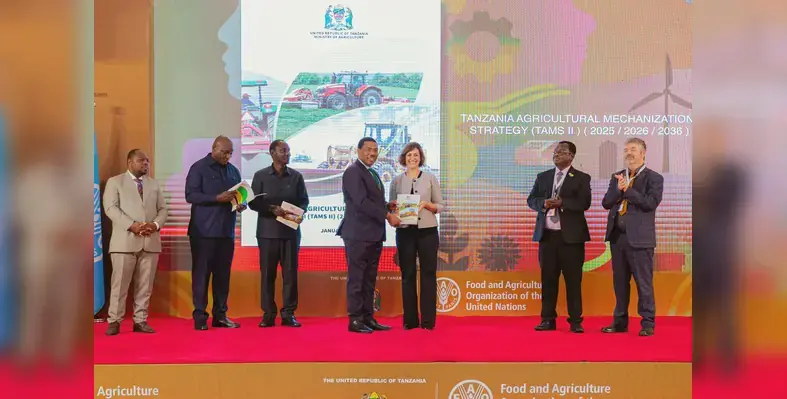
Africa steps up drive to transform farming through mechanisation. (Image credit: FAO)