Adopting autonomous machinery does not always mean replacing conventional farm equipment
For growers with established machinery fleets, investing in specialised implements designed specifically for robotic platforms can add to the cost of automation. French agricultural robotics manufacturer Naïo Technologies is addressing this challenge with SANKA, a fully electric autonomous tool carrier designed to operate conventional farm implements without an onboard driver.
Unveiled as a world premiere at EIMA International 2026 in Bologna, Italy, held from 10 to 14 November, SANKA combines autonomous navigation with standard tractor implements. Designed primarily for perennial crops, the tracked robot allows growers to automate field operations using equipment they may already own, rather than investing in a separate range of robotic implements.
How SANKA uses existing farm machinery
SANKA is equipped with a three-point hitch, power take-off (PTO), hydraulic connections and an onboard electrical supply. The arrangement allows it to operate PTO-driven, hydraulic and electric implements for various agricultural tasks.
Its intended applications include mechanical weeding, tillage, inter-row cultivation and vegetation management. The manufacturer identifies vineyards, orchards, soft-fruit plantations, nurseries and agrivoltaic installations as potential operating environments.
The machine weighs 2.2 tonnes and can carry implements weighing up to one tonne. RTK-GPS guidance works with Naïo's navigation software, developed specifically for agricultural applications. The robot can travel at speeds of up to 6 km/h and is designed for autonomous operation throughout a full working day.
Monitoring and human-detection cameras support driverless field operations, including at night. The safety system is designed to enable the machine to operate independently while monitoring its surroundings.
SANKA combines tracked mobility with precision navigation
Working between established crop rows can involve uneven ground, sloping fields and limited manoeuvring space. SANKA's tracked undercarriage is designed to provide traction and stability in such conditions, with the manufacturer stating that the machine can handle gradients of up to 30%.
Its design also incorporates a patented dynamic weight-balancing mechanism. The system adjusts the machine's centre of gravity according to the weight of the attached implement, helping maintain balance and transfer power to the ground.
The tracked base was developed in partnership with Michelin, initiated in 2024. According to Naïo, the combination of track design and weight distribution improves traction while helping minimise soil compaction. The company also identifies lower energy consumption as an intended benefit of the system.
For growers, the ability to use a single autonomous carrier across multiple operations could reduce the need to invest in multiple task-specific robotic platforms. However, the practical and financial advantages will depend on implement compatibility, field conditions and the range of tasks a farm needs to automate.
SANKA set for 2027 deliveries
SANKA has completed four farming-season field tests and is now entering pre-series production. Naïo has scheduled the first deliveries for the second half of 2027.
The machine also received the EIMA 2026 Technical Evolution Award, recognising its engineering approach. Its commercial introduction will provide a clearer indication of how the platform performs across different cropping systems and with the conventional implements it is designed to carry.
Naïo launches SANKA autonomous agricultural robot
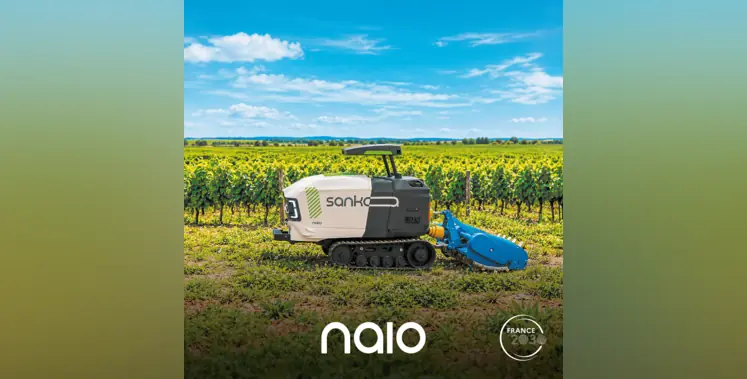
SANKA combines autonomous navigation with standard tractor implements.