



Google and the Gates Foundation have announced an expanded initiative to bring artificial intelligence (AI) tools to 200 million smallholder farmers across Sub-Saharan Africa and South Asia
The programme will provide support for climate forecasting, agricultural productivity and resilience, backed by more than US$100mn in combined funding and dedicated technical expertise from Google researchers.
Announced on 18 September, the multi-year initiative aims to extend the reach of existing AI applications from 50 million farmers to 200 million, focusing on climate adaptation and food security. Funding, research and engineering assistance will support organisations developing and deploying these solutions at scale.
“No matter where they farm, people deserve access to the weather, crop, and soil information that can mean the difference between a good harvest and a failed one. When that information reaches farmers at scale, it’s transformational for their families, their communities, and their economies. We’re proud to work with Google, agricultural partners, and governments across Africa and South Asia to put AI to work solving a problem that climate change is making more urgent,” said Mark Suzman, CEO of the Gates Foundation.
“Our collaboration with the Gates Foundation is about turning the extraordinary potential of computational science into solutions that can make a real difference in people’s lives,” said Maggie Johnson, global head and vice-president of Google.org. "That means going beyond building AI for the Global South to building it alongside the people and communities it is designed to serve. Together, we’re connecting frontier AI with the farmers who feed a third of the world.”
Smallholder farmers operate more than 500 million farms worldwide, most covering less than two hectares, and produce nearly 35% of the world’s food. However, many remain vulnerable to unpredictable weather and lack access to satellite information, financial services and public support that could help them manage agricultural risks.
The Gates Foundation and Google will build on several initiatives to address these challenges.
Strengthening local innovation
The programme will provide funding, computing resources and technical assistance to researchers and innovators working within local ecosystems. Partners include Wadhwani AI and Digital Green in India. The approach aims to ensure that local expertise, data governance and intellectual property remain rooted in the regions where solutions are developed and implemented.
Delivering more precise local weather forecasts
Although meteorologists have access to sophisticated forecasting tools, smallholder farmers often lack weather information detailed enough to guide decisions at individual farm level. The initiative will help bridge this gap by integrating advanced AI forecasting into TomorrowNow, a climate platform co-funded by the Gates Foundation, the UK’s Foreign, Commonwealth & Development Office (FCDO) and Google.org.
Improving the identification of smallholder farms
An estimated 85% of agricultural holdings worldwide are smallholder farms. Their relatively small and irregularly shaped plots can be difficult to distinguish using conventional satellite imagery. As a result, farmers may face difficulties verifying land ownership or cultivation cycles when seeking government programmes, insurance or subsidised agricultural inputs.
To address this challenge, the initiative will build on Google’s Agricultural Understanding Platform, a suite of AI foundation models developed for farmers, government agencies and businesses. The platform is designed to map field boundaries at sub-metre resolution and track crops throughout the growing season.
Google combines satellite imagery from third-party providers with AI to identify smallholder plots and crops, reducing reliance on expensive manual surveys. Meanwhile, the Gates Foundation is funding partners involved in local imagery collection and working with agricultural ministries and CGIAR research centres to prioritise important staple crops.
The Agricultural Land Use (ALU) data layer, one of the most accessed layers on Google Earth and part of Earth AI, already covers India, Malaysia, Vietnam and Indonesia. Further deployments are under way in Kenya, Uganda, Ghana, Rwanda, Zambia and Nigeria. This information can help farmers receive more tailored weather alerts and access additional assistance, including government credit programmes.
Advancing agricultural research and technology
The combined US$100mn commitment is also supporting regional research and infrastructure. This includes collaboration with CGIAR to accelerate the development of crop varieties capable of withstanding drought, heat and disease.
Another priority is improving access to agricultural information in local languages. The initiative will support the development of open-source speech and text datasets covering more than 40 African languages, working with regional networks such as the Masakhane Research Foundation and Digital Umugunda.
These organisations, alongside numerous other partners, will share expertise and coordinate progress through the AI Collaborative: Food Security. The initiative recognises that tackling complex agricultural challenges requires cooperation between technology developers, researchers, governments and local organisations.
Through this expanded partnership, Google and the Gates Foundation aim to turn advanced AI research into practical tools that help farmers manage climate risks, improve harvests and strengthen resilience. By investing in regional institutions, infrastructure and expertise, the programme also seeks to ensure that AI solutions can be deployed widely while being developed and sustained by the communities they are intended to serve.
AI tools to strengthen Africa’s climate-resilient agriculture
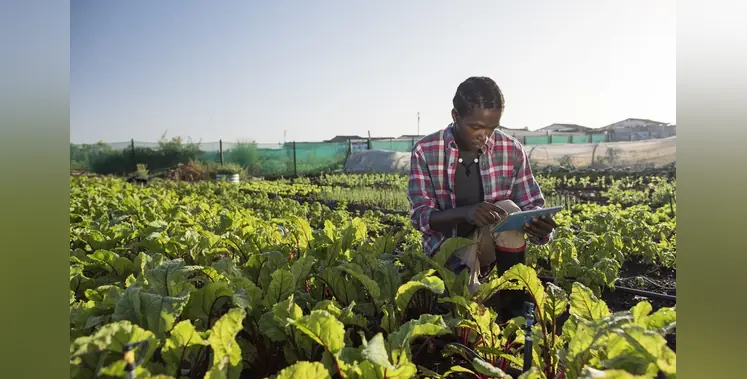
Google and the Gates Foundation commit over US$100mn to scale AI tools for smallholder farmers across Africa. (Image source: Gates Foundation)