Fertiliser recommendations that do not account for local soil conditions can lead to unsuitable nutrient applications and limit their effectiveness in crop production
In Liberia, where fertiliser use has largely relied on blanket recommendations and the last comprehensive soil survey dates to the 1970s, researchers are working to develop more location-specific guidance for rice farmers.
The Regional Hub for Fertilizer and Soil Health in West Africa and the Sahel is leading the research in collaboration with the EU-supported Liberia Land and Soil Resources Knowledge Project (Soils4Liberia), which is led by the International Institute of Tropical Agriculture (IITA). The initiative, titled 'Site-specific nutrient recommendation and soil acidity amelioration in Liberia', focuses on identifying nutrient constraints affecting rice production and assessing suitable nutrient management practices under different soil conditions.
From field experiments to validation trials
Initial field experiments were established in 50 farmer-led and sector-supported fields across Bong, Margibi and Lofa counties starting in July 2025. The research examined nutrient limitations affecting rice productivity and tested fertiliser combinations under different local conditions. Field experiments have been completed, with data analysis and synthesis underway.
Building on that work, validation trials have been established in 25 farmers' fields across the three counties. The current phase is assessing rice performance and the effectiveness of different nutrient management practices under farmers' production conditions.
Harvesting begins in Bong County
Harvest assessments started on 12 November 2026, with the first two farms located in Suakoko District, Bong County. The trials use the NERICA L19 rice variety, with H. Edward Russell, an IITA research associate, leading the harvesting activities. Work will continue at the remaining validation sites in the coming weeks.
Data collected during the assessments will help evaluate trial performance and develop evidence-based nutrient recommendations. Dr Samuel Mesele, Soils4Liberia technical lead and Liberia country focal person for the Regional Hub, is coordinating the activity.
The ongoing efforts, by ensuring that fertiliser recommendations are specific to local soil conditions, will ultimately empower farmers to make better nutrient management decisions, thereby promoting more productive, climate-resilient rice farming systems in Liberia.
Liberia begins rice harvest assessments at 25 validation trial sites
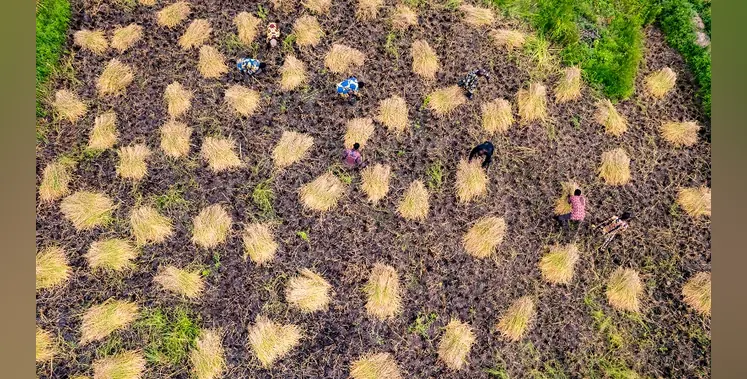
In Liberia, researchers are working to develop more location-specific fertiliser recommendations for rice farmers.