




Ghana’s minister for food and agriculture, Eric Opoku, has called for modern technologies and practical digital skills to become an integral part of agricultural education, equipping young professionals to meet the changing demands of the country’s agriculture sector
He made the call on Wednesday, 30 September 2026, at Kwadaso Agricultural College in Kumasi during the handover of advanced agricultural technology equipment and tools to five agricultural colleges under the Strengthening Digital Agriculture Skills Initiative.
The initiative is being implemented by the World Food Programme (WFP) in partnership with the Ministry of Food and Agriculture (MoFA), the Ghana-India Kofi Annan Centre of Excellence in ICT (GI-KACE), the five beneficiary colleges and other stakeholders. It is funded by the Government of the Republic of Korea through the Korea International Cooperation Agency (KOICA).
The beneficiary institutions are Kwadaso, Wenchi, Ejura, Damongo and Ohawu Agricultural Colleges.
Addressing the gathering, Eric Opoku said the initiative represented more than the delivery of equipment, highlighting its role in developing knowledge, skills and innovation among young people.
“What we are witnessing today goes beyond the handover of agricultural equipment. It represents an investment in knowledge, skills, innovation and, most importantly, in the young men and women who will shape the future of Ghanaian agriculture.”
He explained that the equipment would give students practical exposure to technologies increasingly used in modern farming, including data-driven decision-making, soil and moisture monitoring, weather information and precision agriculture.
The equipment comprises soil testers, moisture meters, greenhouse environmental control kits, Internet of Things (IoT) sensor kits, weather stations, GPS devices, computers, 15 mini drones, drone flight and agricultural spraying simulators, and agricultural data-processing software.
The Minister emphasised that agricultural training must keep pace with technological developments across the sector.
“We cannot address the agricultural challenges of today using only the tools and approaches of yesterday,” he said.
He urged college principals and instructors to incorporate the equipment into their teaching and practical training programmes, ensuring students have meaningful opportunities to work with the technologies.
He also thanked WFP, KOICA, GI-KACE, the Commission for Technical and Vocational Education and Training (CTVET) and other partners for their support.
Digital skills for the next generation of agricultural professionals
KOICA Ghana country director Dong Wan Woo said the handover was part of the KOICA-WFP partnership on Youth Economic Empowerment through Digitalization for Resilience in Food and Nutrition Security and Improved Livelihoods.
"The real value of this equipment depends on how it is used," he said, urging the colleges to incorporate the tools into practical training and ensure proper maintenance.
He added that Korea's own development experience had demonstrated "the importance of investing in people, skills and technology," reaffirming KOICA's commitment to working with the Government and people of Ghana.
Dong noted that the rapid transformation of agriculture made practical experience with modern technologies increasingly important for young professionals, alongside their classroom education. He encouraged the colleges to use and maintain the equipment effectively to maximise its benefits for students.
Project coordinator Kyore Yoo explained that the initiative had identified shortcomings in digital infrastructure, learning resources and students' practical exposure to emerging agricultural technologies across the five colleges.
He said GI-KACE, in collaboration with CTVET and other stakeholders, had developed a competency-based Digital Agriculture Training Programme. The curriculum covers smart agriculture, digital literacy, data-driven decision-making, precision agriculture and digital agribusiness.
Kyore encouraged students to develop their skills in technology, innovation, entrepreneurship and problem-solving, emphasising their potential role in shaping the future of Ghanaian agriculture.
“You are not simply being trained to participate in agriculture as it exists today. You are being prepared to help shape the agriculture that Ghana will depend on tomorrow.”
Training instructors to support digital agriculture
The initiative will also provide further training for instructors and tutors to support the effective integration of digital technologies into agricultural education.
A five-day Training of Trainers programme is planned for instructors and tutors, followed by specialised training in drone simulators and data-processing software.
Instructors will also receive practical drone training through the University of Mines and Technology to support certification by the Ghana Civil Aviation Authority.
MoFA, WFP and KOICA equip five colleges for digital farming
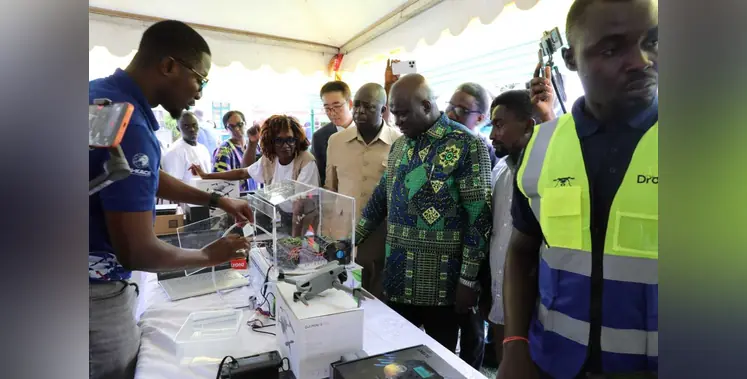
Ghana equips five agricultural colleges with digital tools to advance precision farming. (Image source: MoFA)