


cb.web.local

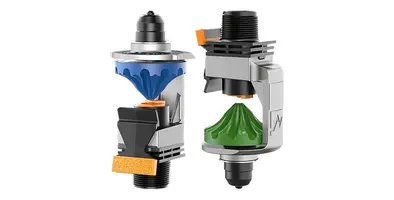
These new additions are designed to improve upon the performance of the well-known R55. (Image credit: Nelson Irrigation)

Nelson Irrigation has introduced two new models to its end-of-pivot sprinkler line: the R65 VT and the inverted R65i VT

These new additions are designed to improve upon the performance of the well-known R55, with a particular focus on increased reach and enhanced water distribution uniformity. Both sprinklers operate efficiently within a low-pressure range of 15 to 60 psi (1 to 4 bar), delivering flows from 4.3 to 23.6 m³/hr (20 to 106 gpm). Their throw radius spans from 10.6 to 16.4 metres (35 to 54 ft), allowing broad coverage across diverse field types.

The design upgrades include a slimmer body and a more advanced nozzle system that helps achieve better distribution even under lower pressure conditions. These improvements make the R65 series highly adaptable for a variety of pivot irrigation setups. Farmers can use these sprinklers to cover the entire pivot circle, target corner areas, or work in conjunction with a high-volume Big Gun® sprinkler, depending on the needs of their fields.

The inverted model, the R65i VT, has been engineered for easier installation and improved flushing performance, thanks to a newly designed green plate. This feature is particularly valuable for maintaining reliable operation at the far ends of irrigation systems. Both versions use focused water streams that enable longer throw distances and feature a 270-degree spray pattern. This pattern is designed to irrigate behind the sprinkler, overlapping with the pivot’s regular sprinkler layout to maintain consistent soil moisture even at the field’s outer edges. The updated #90 nozzle works seamlessly with the green plate, simplifying maintenance and improving compatibility across components.

One of the standout features of these sprinklers is their integration of Nelson’s Rotator® technology. In use for over three decades, this technology is known for its ability to produce strong, wind-resistant streams that deliver water more evenly than traditional droplet-based methods. Rotator sprinklers also reduce application intensity, which allows for better soil absorption and less surface runoff.

In summary, the R65 VT and R65i VT offer a smart, durable solution for modern pivot irrigation systems. They bring together energy efficiency, even water application, and dependable performance—all tailored to help farmers achieve more effective irrigation with less input.
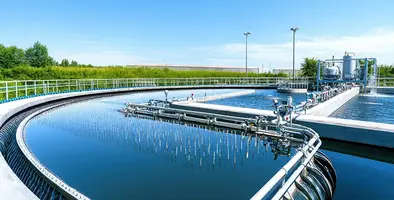

EA plans to conduct over 10,000 inspections of water company assets.

The UK government has announced its largest-ever budget to tackle water pollution, providing the Environment Agency (EA) with over £189 million for the 2024/25 financial year

This investment marks the biggest increase in enforcement powers in a decade and is part of the government’s broader Plan for Change.

EA responsible for inspecting water companies and prosecuting environmental damage, will use the funding to recruit more enforcement officers, upgrade equipment, and implement modern technologies. Steve Reed, Environment Secretary said, "This government is cleaning them up, including the biggest boost to enforcement in a decade paid for by the water companies responsible for it.

In 2024 alone, the EA plans to conduct over 10,000 inspections of water company assets. Since July 2024, it has launched a record 81 criminal investigations into pollution incidents involving water companies.

The budget for the EA has increased by 64% since the 2023/24 financial year. Importantly, this increase is fully funded by charges paid by water companies—not by taxpayers.

 Reed emphasized the public's growing concern: "The public are furious about sewage pollution in our rivers, lakes and seas." He added, "Our changes give the water watchdog the resources they need to tackle pollution and clean up our rivers, lakes and seas for good."

To ensure efficiency, EA has committed to strict spending targets. In the current year alone, it has achieved savings of over £23 million.

Further support will come through a proposed new levy on the water sector, currently under consultation. Introduced under the Water (Special Measures) Act, this levy will help the EA recover enforcement costs, allowing quicker action against pollution.

The EA’s efforts will also expand to the agricultural sector, with plans to carry out 6,000 farm inspections annually by 2029. These inspections aim to reduce runoff and pollution from farms into rivers and lakes. This major funding and new powers underline a strong push to improve water quality across the UK.

Eric Muuga explained the delay in the Thwake Dam. 

Eric Muuga, Kenya's water and irrigation cabinet secretary explained to senators the reasons behind the delay in the construction of the Sh42.3 billion Thwake Dam 

He cited the Russia-Ukraine war and the COVID-19 pandemic as factors affecting progress. Muuga faced skepticism from lawmakers, especially Makueni Senator Daniel Maanzo, who questioned how these events impacted a project that stalled a year ago.

Muuga argued that the war caused a shortage of explosives needed for the dam’s foundation, while the pandemic led to a reduced workforce. He also mentioned that challenges with the dam’s height and the weak foundation required additional construction work. Kitui Senator Enoch Wambua expressed doubt about the contractor’s presence on-site, recalling an experience where excuses related to Covid-19 and later the Ukraine war were used for delays.

Muuga clarified that Thwake Dam is designed to be the largest rock-filled dam in Kenya, with a capacity of 688 million cubic metres. He stressed the importance of allowing time for the foundation’s embankment to settle to prevent future issues, stating that this settlement could take six to nine months. The cost breakdown reveals that the African Development Bank is providing Sh35. 6 billion, and the Kenyan government is contributing Sh6.71 billion.

Initially scheduled for fulfillment in December last year, the project is now set for completion by October 30, 2025. Upon completion, the dam will supply water to 1.3 million people, generate 20 megawatts of hydropower, and irrigate 100,000 acres, benefiting various areas in both Makueni and Kitui counties.

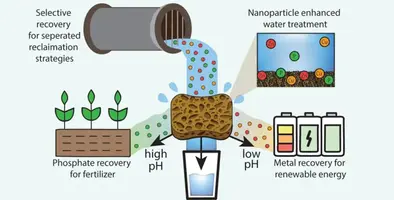
Illustration showing how the sponge nanocomposite material recovers phosphate and metals from water. (Image source: Kelly Matuszewski, Northwestern University)

Researchers have created a functional sponge that is capable of efficiently soaking up certain pollutants from water and then releasing them on demand

Industrial manufacturing and agriculture, in particular, experience mineral and fertiliser loss due to runoff, leaving valuable non-renewable resources as pollutants in bodies of water. Those resources include heavy metals like zinc and copper and also phosphate. 

The innovation presents a reusable and low-cost solution for cleaning storm runoff while simultaneously recovering valuable metals like zinc and copper, as well as phosphate. Using surface iron oxide nanoparticles specialised for capturing specific contaminants, the sponge collects the minerals and then discharges them only when triggered by changes in pH. These findings were achieved by researchers at Northwestern University and published in the American Chemical Society's journal Environmental Science and Technology Water.

Doctoral student and first author on the paper, Kelly Matuszewski believes it is important to understand the interaction between these minerals and utilise them, rather than finding ways to discard them. Through her research she discovered that lowering water pH flushed out the captured copper and zinc from the sponge, while raising water pH loosened the phosphates.

In an attempt to commercialise the sponge-based technology, Vinayak Dravid, co-author and Northwestern professor of materials science and engineering has co-founded a startup with additional NSF support through the Small Business Innovation Research programme, which will further develop the material for real-life scenarios.

"The technology can be used as a universal sorbent or 'catch-all,' or it can be tailored to certain groups of contaminants like metals, plastics or nutrients," said Dravid. In their future research, the team plans to account for biofilms, clogging or water flow dynamics on the sponge's performance, while also testing the maximum mineral levels the sponge can absorb.


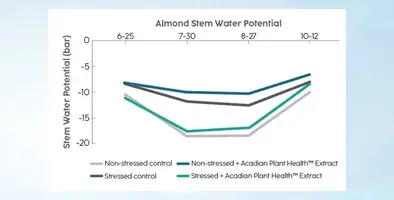
Results show almonds treated with Acadian biostimulants with improved Stem Water Potential in both stressed and non-stressed situations. (Image source: Acadian Plant Health)

Acadian Plan Health through its multi-year California almond water study, today, released expanded results demonstrating how biostimulant technologies can help growers reduce water use while maintaining yield

As chronic water shortages loom over the world, water reduction programmes are working to lower the local almond industry's water use by 20% from 2020-2025. Starting in 2026, California is looking to significantly reduce its water use, thus making biostimulant technologies all the more relevant for almond growers.

Starting from 2021, chosen almond trees were subjected to Acadian Organic treatments, following which weekly assessments of midday stem water potential were performed. Results from these assessments showed a consistent improvement in stem water potential and kernal weight in regular and deficit irrigation situations. 

According to director of Research and Development at Acadian Plant Health, Holly Little, the results were found to be promising. She highlighted that besides lowering stem water potential, these biostimulants can also lower the frequency or volume of irrigation required for the growth of healthy almond trees, while at the same time protecting yields. 

"As environmental and regulatory water restrictions challenge global agriculture, adopting multidisciplinary and holistic water management will be key to sustaining future orchard systems," said UC Davis Cooperative Extension Orchard Systems specialist Dr Guilia Marino. "These preliminary results suggest Acadian Plant Health's biostimulant technology has a positive effect on almond tree water status under experimental conditions and may reduce tree stress. Additional research will help determine the product's impact on orchard productivity, as well as tree physiology and productivity."

More Articles …